

The Legacy of the Kinshū Line — The Spirit and History of Gunrōeisō
Introduction

This article is based on a memoir written by the master of Gunrōeisō,
a renowned kennel that dedicated itself to the preservation and development of the Tetsu line of the Kishu Ken
within the Japan Dog Preservation Society during the Shōwa and Heisei eras.
Gunrōeisō played a vital role in maintaining the dignity and authenticity of the Tetsu bloodline,
producing many outstanding dogs that represented the true spirit of the Japanese native breeds.
As successors to Gunrōeisō’s philosophy and bloodline,
we present this article with the deepest respect for our teacher,
as a record to convey the spirit of Gunrōeisō and the significance of preserving the Tetsu lineage to future generations.
1. Encounter with the Kishu Ken
In 1979, I first encountered a descendant of Tetsuyuki-gō, a Kishu Ken that had won the Prime Minister’s Award.
At that time, I was living in an apartment and could not own a dog,
yet the photograph in Aiken no Tomo (Dog Lovers’ Companion) left a deep impression on me.
When I finally met the female dog in person at Mr. Endō’s kennel, I was struck by her commanding presence —
dignified, noble, and filled with the soul of the true Japanese dog.
2. The Depth of the Tetsu Line
Under the guidance of Mr. Endō, I studied the characteristics of the Tetsu, Mie, and Kantō lines.
Each had its strengths, yet the Tetsu line fascinated me with its depth and balance —
the harmony of power, grace, and spiritual beauty that defines the essence of the Japanese dog.
Among the many show dogs I observed, those of the Tetsu line stood apart in their poise and natural dignity.
3. The Golden Age of the Japan Dog Preservation Society

From the late Shōwa to early Heisei era, the Society entered what can only be described as its golden age.
Exhibitions across Japan drew extraordinary dogs and passionate breeders.
Each breeder’s philosophy was reflected in the dogs they presented.
The air was filled with pride, discipline, and deep respect for the native breeds.
It was an era when the concept of “what a true Japanese dog should be”
was pursued with earnest devotion.
4. Change and Challenge

As time passed into the Heisei period, the Kantō line began to dominate major awards.
While uniform beauty increased, individuality and depth began to fade.
Though the Tetsu line became rarer, its distinctive expression,
structure, and temperament remained invaluable —
a living heritage that must never be lost.
5. The Philosophy of Gunrōeisō

At Gunrōeisō, the philosophy of breeding was clear:
preserve the Tetsu line through sound, selective breeding
to produce Kishu dogs of health, nobility, and spirit.
Avoiding excessive inbreeding, we sought balance —
dogs that embody both strength and gentleness.
When Yamasachi-me, a female from Wakayama Prefecture,
won the Prime Minister’s Award, it symbolized
that the spirit of the Tetsu line was still alive in modern times.
6. Teachers, Mentors, and Respect
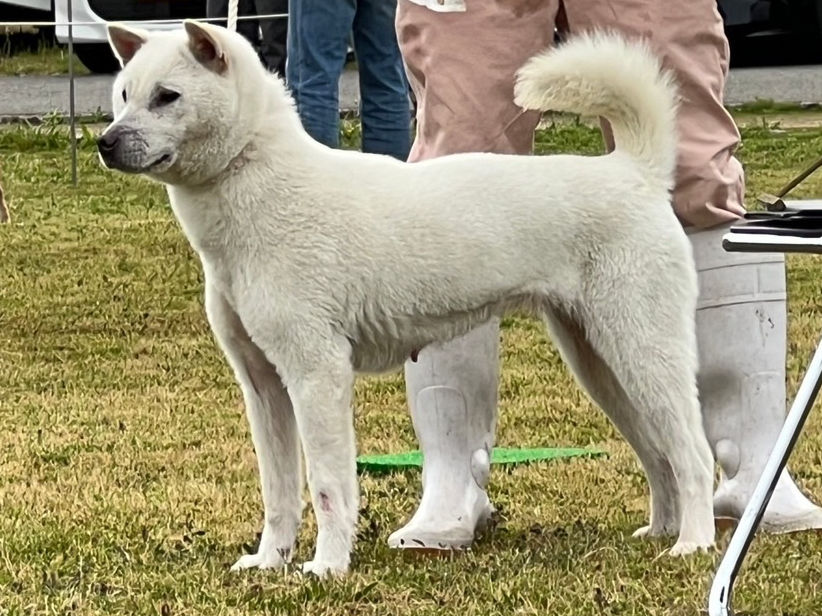
Mr. Endō, Mr. Miyashita, Mr. Shimizu, Mr. Urata —
they were not only breeders but true teachers who nurtured both dogs and people.
The spirit of Gunrōeisō lives on,
not merely through bloodlines, but through the mutual trust between human and dog.
7. Conclusion — The Soul of the Kishu Ken

The Kishu Ken is more than a breed.
In its eyes lives the memory of coexistence between humans and nature,
and the aesthetic spirit of Japan itself.
Preserving the Tetsu bloodline is not only a task of breeding,
but an act of honoring the legacy of those who came before us —
a pledge to carry the noble spirit of the Japanese dog into the future.


Comments